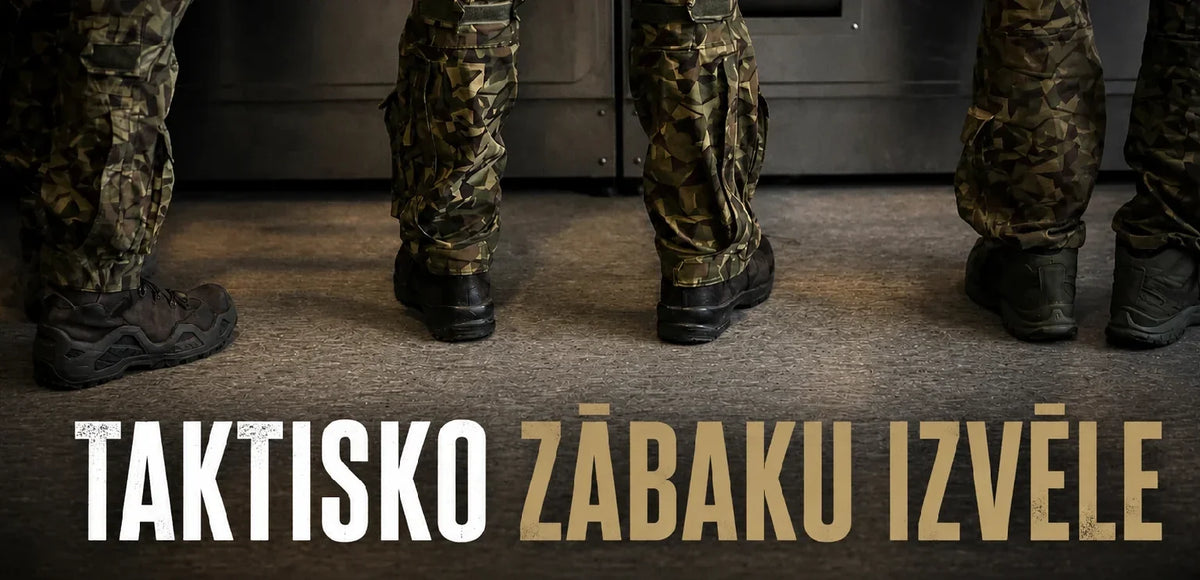
Tactical boots should not be chosen solely based on brand, appearance, or which shoes feel the lightest and most comfortable in the first five minutes. Boots that feel great in a store, office, or shooting range will not always be suitable for multi-day field exercises, a wet forest, or prolonged movement with full gear.

I have served in the National Armed Forces for 25 years and currently continue my service in the National Guard. As Chief of Staff, I have less intensive movement and more office work, so I most often wear Salomon XA Forces or LOWA Zephyr Mid daily.
However, when I served in an infantry unit and spent significantly more time in field conditions, I chose higher and more stable LOWA Z-8S boots. All these models can be a good choice, but each is designed for a different load and usage environment.
Quick selection: which boots are suitable for what?
Headquarters and everyday use
Lightweight, mobility, and comfort indoors.
Salomon XA Forces, LOWA Zephyr, 5.11Field exercises
Stability, durable sole, and grip.
LOWA Z-6S, Z-8S, Salomon Quest 4DSummer
Breathability, lighter weight, and quick drying.
Salomon Jungle, LOWA Zephyr without GTX, 5.11Winter
Insulation, space for socks, and moisture protection.
Salomon Toundra, Salomon Quest 4D HighOne universal pair
Balance between weight, stability, and protection.
LOWA Z-6S or LOWA Z-8SThe most comfortable boot is not always the most suitable
One of the most common mistakes is to choose boots based solely on the initial impression of comfort. A person tries on several pairs in a store and chooses the lightest and softest.
If the footwear is intended for indoor work, a shooting range, driving, or everyday use, this may be the correct choice. Problems begin if the same light footwear must be used to move over gravel, roots, rocky terrain, or forest roads, especially with a bulletproof vest, backpack, and other equipment.
Lighter tactical footwear tends to have a thinner and more flexible sole, less protection against terrain irregularities, and less stability on uneven ground.
A thin and flexible sole is not a disadvantage in itself. It reduces the weight of the footwear and provides better foot mobility. However, during a long hike, it may not sufficiently absorb shocks and protect the foot from pressure caused by stones, roots, and other uneven surfaces.
First, determine the primary use of the footwear
There is no single model of tactical boots that would be equally suitable for the office, summer hiking, winter survival, and multi-day field exercises.
Before choosing, you need to assess how much walking will be involved, what kind of surface will be covered, how heavy the equipment will be, what weather conditions the footwear will be used in, and how much time will be spent indoors or in transport.
For daily service and indoor work
If most of the day is spent in headquarters, an office, a car, or a well-maintained area, it is not necessary to choose heavy field boots. Low or mid-high tactical footwear with good foot mobility and sufficient cushioning will be more suitable.
Practical examples include LOWA Zephyr MID and lighter 5.11 tactical footwear models. These are usually more comfortable for indoor wear and driving. However, light tactical footwear does not automatically become a full-fledged boot for intense field exercises.
For field exercises and heavier loads
In field conditions, a more stable construction, a more durable sole, and better foot support are required. This becomes especially important when moving for extended periods with a backpack, bulletproof vest, and other equipment.
For such use, it is worth looking at LOWA Z-6S, LOWA Z-8S, Salomon Quest 4D Forces Mid, or other mid-high and high boots with a stable sole. In prolonged movement, a slightly heavier but more stable boot will often be less tiring than a very light shoe with insufficient foot support.

Low, mid, or high tactical boots?
The height of the boot affects not only its appearance. It determines external ankle protection, mobility, and how easily sand, mud, or snow can get into the footwear.
| Height | Most suitable use | Considerations |
|---|---|---|
| Low | Indoors, shooting range, transport, warm and dry weather | Lighter and more mobile, but less external protection |
| Mid-high | Daily service, hikes, and moderate field exercises | The most versatile category |
| High | Challenging terrain, heavier equipment, mud, and snow | More protection, but heavier weight and less mobility |
A higher shaft creates a more stable feeling, protects the ankle area from branches and impacts, and reduces the chance of snow or mud entering the boot. However, this alone does not guarantee protection against ankle sprains. The risk of injury is also influenced by fitness, fatigue, previous injuries, load weight, terrain, and movement technique.
Sole thickness, cushioning, and stability
These terms are often confused, although they describe different footwear properties.
- Cushioning helps absorb shocks.
- Sole stiffness limits excessive foot flexing and helps distribute the load.
- Outsole tread provides grip on the specific surface.
- Sole protection construction reduces pressure on the foot from stones, roots, and other irregularities.
A very soft sole may seem exceptionally comfortable in the store, but with heavy equipment, it will not always provide the necessary stability. Conversely, a very stiff boot may be suitable for challenging terrain but unnecessarily tiring if the entire day is spent on a hard, flat floor.

Boots with or without membrane?
GORE-TEX and other waterproof membranes are useful in wet grass, rain, and changing weather conditions. However, a membrane is not automatically the best solution for all seasons and all tasks. A membrane helps in wet conditions, but for boots with a membrane, and especially in combination with suede or nubuck, proper footwear care is also essential.
| Variant | Advantages | Disadvantages |
|---|---|---|
| With membrane | Protects against external moisture; practical in wet grass, rain, and wet snow | Can be too warm in hot weather; dries slower if water enters from above |
| Without membrane | Better air circulation; usually dries faster | Water penetrates faster; socks and drying must be planned more carefully |
A membrane helps keep water out from the outside, but it cannot prevent foot perspiration. Therefore, a waterproof boot does not always mean a completely dry foot.
For summer, it is worth considering Salomon Jungle, LOWA Zephyr without GORE-TEX membrane, or suitable light 5.11 models. However, in Latvia's variable spring and autumn conditions, a membrane will often be a practical advantage.
Winter requires winter boots
A thicker sock does not always turn ordinary summer boots into winter boots. Moreover, a too-thick sock in a tight boot can reduce the air layer around the foot, restrict blood circulation, and achieve the opposite effect — the foot will start to get cold faster.
For winter footwear, insulation, space for appropriate socks, protection against moisture, sole grip, planned activity, and the time spent without movement should be considered.
MilCamp offers winter models such as Salomon Toundra Forces and Salomon Quest 4D Forces High. Toundra is an insulated winter model for extremely cold conditions, while Quest 4D High provides a high construction, stability, and protection against moisture.
Do not rely solely on the manufacturer's stated lowest temperature. The sensation of cold is significantly affected by activity intensity, socks, duration of time spent outdoors, and each person's individual cold tolerance.
The right size is more important than the brand
Among MilCamp customers, one of the most common problems is choosing the wrong size, especially when ordering shoes online.
The same European size for different manufacturers' footwear may fit differently. Even different models from the same manufacturer will not always be the same in terms of inner length, width, and shape.
Not only the foot length is important, but also the foot width, arch, toe space, heel fixation, the overall internal volume of the boot, and the specific model's last.
- Measure both feet and choose the size according to the longer one.
- Measure your feet in the afternoon when they may be slightly swollen.
- Try on the boots with the socks you will use for duty or hiking.
- Check that your toes have room for free movement.
- Make sure your heel does not lift excessively.
- When imitating downward movement, your toes should not hit the front of the boot.
- Do not buy boots that are too large just to wear very thick winter socks in them.
For initial checking, you can remove the insole and stand on it. This allows for an approximate assessment of foot length and width but does not show foot arch, heel fixation, and overall boot volume.
Wrong size will not break in
A new boot may become slightly more flexible and adapt to foot movements during use. However, do not expect improperly sized or shaped footwear to become suitable over time.
Breaking in will not lengthen a boot that is too short, make a narrow toe box wide enough, correct a last that does not fit the foot, or eliminate pronounced pressure points.
Socks are part of the footwear system
Even well-chosen boots can cause problems if inappropriate socks are worn. Blisters are caused not only by incorrect size but also by friction, moisture, heat, sock folds, and prolonged pressure in one part of the foot.
Cotton socks absorb moisture and stay wet for a long time. For prolonged movement, technical synthetic or merino wool blend socks are usually more suitable, as they wick away moisture better and dry faster.
Why change different socks during a hike?
On longer hikes, it is worth taking not only several identical pairs of socks but also socks with different weaves, padding, patterns, or from another manufacturer.
By changing the sock model, the areas where seams, thickenings, compression zones, and fabric structure act on the foot change slightly. This prevents friction and pressure from concentrating at exactly the same points throughout the hike.
This does not guarantee that blisters will not form, but it can help reduce the risk of their occurrence, together with properly sized boots and regular changing of dry socks.
Waterproof socks as backup protection
In wet conditions, waterproof socks, such as Sealskinz or NOORD, are a practical solution.
They cannot literally replace boots but can be considered a compact backup layer of protection in a situation where regular boots are soaked or water has entered over the top of the shaft.
- Helps keep feet dry in wet boots.
- Protects against cold external moisture.
- Takes up significantly less space than a spare pair of shoes.
- Can allow you to continue the task when boots cannot be dried.
On multi-day hikes or field exercises, they can, to some extent, perform the function of "backup footwear" – not by replacing the boot's construction, but by providing a backup waterproof barrier for the foot.
It should be noted that even in waterproof socks, the foot can sweat during intense movement. They are best used for specific wet conditions, rather than being worn automatically all the time.

If one universal pair of boots is needed
If one pair is needed for daily service, field exercises, and hikes, I would first look at LOWA Z-6S or LOWA Z-8S.
- LOWA Z-6S will be slightly lighter and more mobile.
- LOWA Z-8S will provide a higher construction and more support in challenging terrain.
However, even a universal boot will have compromises. It will not be as light as Salomon XA Forces in summer and will not be as warm as Salomon Toundra in winter.
For a person who uses tactical footwear regularly, at least two pairs will usually be more practical: a lighter pair for everyday use and summer, and a more stable pair for field exercises, wet weather, and heavier loads.
This allows choosing footwear more suitable for specific weather conditions and fully drying one pair while the other is in use.
How to choose tactical boots: a brief summary
- Determine the usage environment and anticipated weather conditions.
- Evaluate the duration of movement and the total weight of the equipment.
- Choose boot height and sole stability appropriate for the task.
- Decide whether a waterproof membrane is needed.
- Check not only the size number but also the width, instep, and heel fixation.
- Try on boots with the socks you will actually use.
- Do not rely on an incorrectly sized boot stretching out later.
Frequently asked questions
Which tactical boots are the most versatile?
If you need one pair for daily service, training, and hiking, it's worth looking at LOWA Z-6S or Z-8S first. The Z-6S will be lighter, while the Z-8S will provide a higher construction and more support.
Should tactical boots be chosen in a larger size?
Not always. One should consider not only the size number but also foot length, width, instep, and the specific model's last. Boots should be tried on with the socks they will be used with.
Are GORE-TEX boots suitable for summer?
They can be suitable for cool and wet summers, but in hot and dry conditions, boots without a membrane will generally be more breathable and dry faster.
Do LOWA boots stretch when worn?
Based on practical experience, significant stretching should not be relied upon. The MONOWRAP construction holds the foot firmly, so the correct length and width must be chosen from the start.
How to reduce the risk of blisters during a hike?
Choose correctly sized boots, moisture-wicking socks, and change them in time. Changing sock models can alter pressure and friction points on the foot.
Conclusion
Tactical boots should not be chosen based solely on weight, appearance, or initial comfort. First, evaluate the usage environment, load, season, terrain, and required foot support.
Lightweight footwear can be an excellent choice for staff duty, the shooting range, and everyday use. For field exercises with full equipment, a slightly heavier boot with a more stable construction and a more durable sole might be more suitable.
Equally important are correctly chosen socks, the ability to change them, and fully drying footwear after use. For wet conditions, waterproof Sealskinz or NOORD socks can become a valuable backup layer of protection.
Not sure about the size or model?
At the MilCamp store in Kadaga, you can try on tactical boots from various manufacturers and compare their length, width, and foot fixation.
View tactical boots Store location